Chattanooga sits on a mix of residual soils from the Cumberland Plateau and alluvial deposits along the Tennessee River. That variability often catches road designers off guard. We have seen projects where a uniform pavement structure failed within two years simply because the subgrade changed from stiff clay to soft silt across a 50-meter stretch. A proper flexible pavement design must account for these lateral variations through targeted site investigation. Before laying any asphalt, we recommend correlating the subgrade support with a CBR test performed on undisturbed samples from each distinct soil zone. That single parameter drives the required structural number and layer thicknesses.
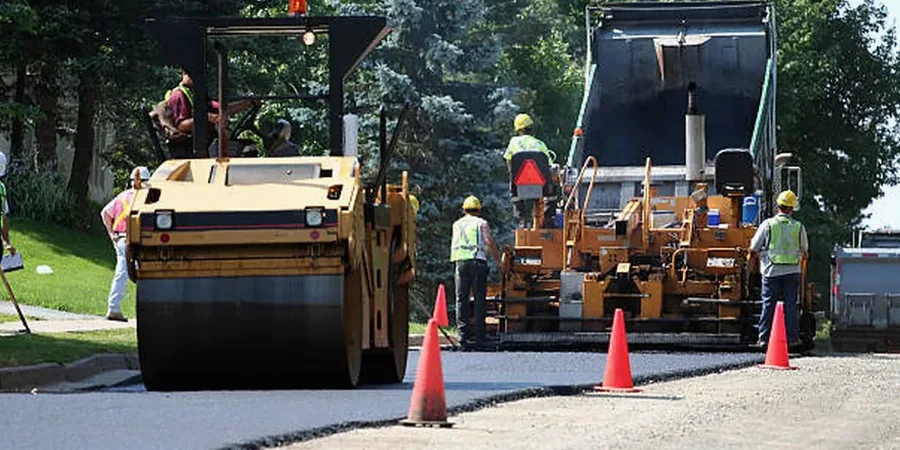
Subgrade CBR can drop from 8 to 3 after a wet season. Flexible pavement design without moisture sensitivity analysis is a gamble.
Technical details of the service in Chattanooga
Local geotechnical conditions in Chattanooga
ASCE 7 and the IBC reference the AASHTO Guide for pavement structural design, but many local specs in Chattanooga still default to outdated layer coefficients. The risk here is twofold: first, using a generic CBR value without considering seasonal moisture changes in the clay subgrade; second, ignoring the frost penetration depth in the valley floors, which can reach 12 inches during a cold snap. A flexible pavement design that skips a site-specific moisture-density analysis often shows premature cracking within three winters. Our lab runs the standard Proctor (ASTM D698) and soaked CBR (ASTM D1883) to capture that worst-case scenario.
Our services
We provide the full chain of services needed to produce a reliable flexible pavement design in Chattanooga: from soil classification through structural number calculation.
Subgrade Investigation & CBR Testing
We drill test pits and borings at critical locations, classify soils per ASTM D2487, and run soaked CBR tests on recompacted samples. The results feed directly into the AASHTO structural number equation.
Traffic Analysis & ESAL Calculation
Using Chattanooga-area traffic counts from TDOT, we estimate the 20-year equivalent single-axle loads. This step determines whether a thin asphalt overlay or a full-depth structure is needed.
Pavement Cross-Section Design
We combine subgrade Mr, traffic, and reliability to recommend layer thicknesses and materials (asphalt concrete, base, subbase). Deliverables include a design report with construction specifications.
Common questions
What is the typical cost range for a flexible pavement design study in Chattanooga?
For a standard road or parking lot project, the geotechnical investigation and design report typically fall between US$1.550 and US$5.460. The variation depends on the number of test pits, required CBR tests, and traffic analysis depth. Contact us for a site-specific quote.
How deep should we investigate the subgrade before pavement design?
We typically explore to at least 5 feet below the proposed subgrade elevation, or until we encounter bedrock. In Chattanooga's clay zones, the active moisture depth can reach 4 feet, so sampling below that layer is essential to capture the stable subgrade support.
Can I reuse a flexible pavement design from a neighboring site in Chattanooga?
Not recommended. Soil conditions vary dramatically even within the same neighborhood — a site on the ridge might have CBR 8 while a site 200 meters away in the valley has CBR 3. A site-specific investigation is the only reliable way to avoid premature failure.