ASCE 7 and the International Building Code require site-specific subsurface characterization for most structures in Chattanooga, where the Valley and Ridge province creates complex geology with interbedded limestone, shale, and alluvial deposits along the Tennessee River. Electrical resistivity and Vertical Electrical Sounding (VES) provide continuous 2D or 1D profiles of the subsurface without drilling, making them ideal for mapping the depth to bedrock, locating groundwater, and identifying solution features like cavities or clay-filled seams. For projects requiring direct soil sampling alongside geophysical data, the team typically combines VES with a targeted study of soil classification to correlate resistivity values with actual soil types and a permeability field test when hydraulic conductivity is a design concern.
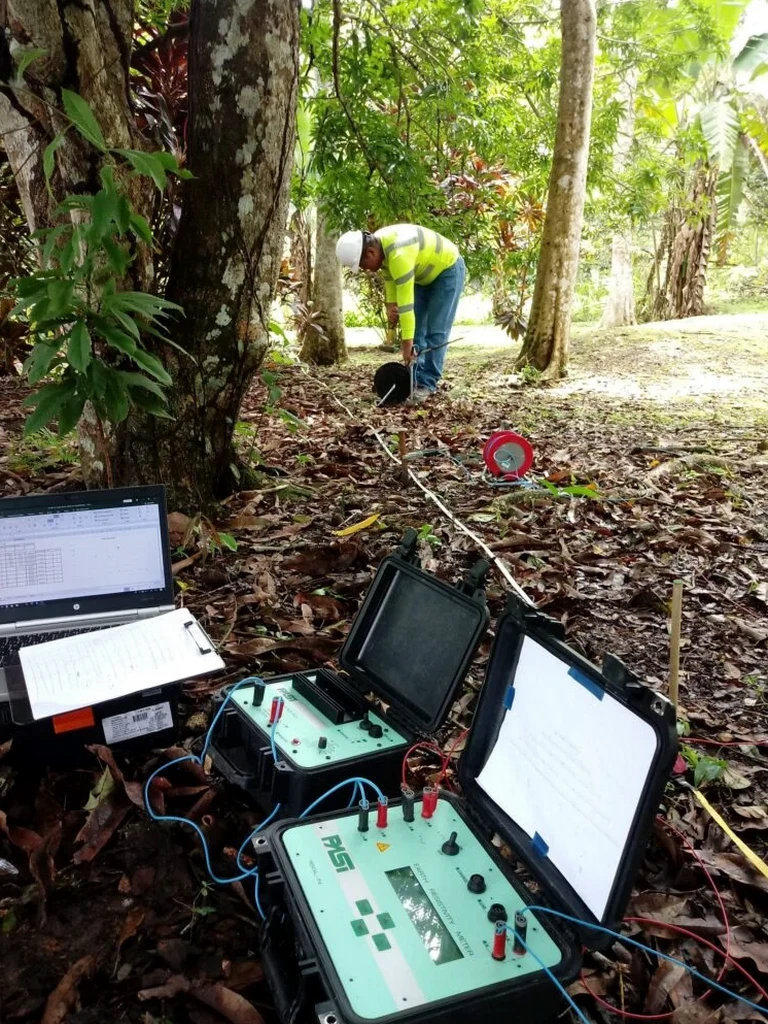
In Chattanooga, limestone bedrock can drop from 5 to 30 feet within a single building footprint, making continuous geophysical profiling essential for safe foundation design.
Technical details of the service in Chattanooga
- Limestone and chert: 800–5,000 ohm·m, depending on fracturing and water content
- Silty clay and fill: 10–80 ohm·m, typical of the river terraces
- Saturated sand and gravel: 100–400 ohm·m, found along the Tennessee River floodplain
Field demonstration
Local geotechnical conditions in Chattanooga
The resistivity instrument consists of a transmitter, receiver, and four steel electrodes connected by multi-core cables. In Chattanooga, the team deploys this equipment along linear profiles that often cross steep terrain or active construction sites near the Chattanooga Riverwalk or the slopes of Lookout Mountain. The primary operational risk is poor electrode contact in dry, rocky ground or on exposed limestone, which produces high contact resistance and noisy data. To mitigate this, the field crew applies a saline solution at each electrode and uses a stainless steel hammer to drive electrodes deeper into the soil. If the contact resistance remains above 2 kΩ, the survey switches to a higher-voltage transmitter or a capacitively coupled array.
Our services
We offer two complementary resistivity-based services tailored to Chattanooga's geological context:
Vertical Electrical Sounding (VES)
One-dimensional resistivity sounding using the Wenner array at 5 to 15 electrode spacings. Output includes layer resistivity, thickness, and interpreted geological boundaries. Ideal for depth-to-bedrock estimation and groundwater exploration in the Chattanooga area.
2D Electrical Resistivity Tomography (ERT)
Multi-electrode continuous profiling with inversion to produce a resistivity cross-section. Used for cavity detection, landfill delineation, and slope stability assessment on projects near Moccasin Bend or the Tennessee River.
Common questions
How deep can a VES survey reach in Chattanooga's limestone terrain?
With standard Wenner spacings up to 20 m, VES can reach depths of 30 to 50 m in the Valley and Ridge geology. The actual depth depends on the resistivity contrast between the limestone bedrock and the overburden; in areas with thick alluvial clay, the penetration depth may be reduced.
What is the typical cost of an electrical resistivity survey in Chattanooga?
For a standard VES with 10 soundings on a residential lot, the cost ranges from US$580 to US$1,120. A 2D ERT line of 200–400 meters costs between US$1,200 and US$2,500, depending on access and terrain. Contact us for a site-specific quote.
Can electrical resistivity detect karst cavities under a building site in Chattanooga?
Yes, 2D ERT is the preferred method for mapping solution features in limestone. Cavities filled with air or clay produce a resistivity contrast of 2–10 times compared to intact rock. However, cavities smaller than half the electrode spacing may not be resolved, so the survey design must match the target size.
Do I need a permit to run a resistivity survey in Chattanooga?
No permit is required for non-invasive geophysical surveys on private property. For surveys in public rights-of-way or near the Tennessee River, a temporary occupancy permit from the City of Chattanooga or the Tennessee Department of Transportation may be needed. Our field crew handles all permitting.