Geotechnical laboratory testing forms the backbone of safe and efficient construction across Chattanooga, providing critical data on soil and rock behavior that directly influences foundation design, slope stability, and earthwork specifications. This category encompasses a comprehensive suite of physical and mechanical tests performed on subsurface samples recovered during site investigations, ranging from basic classification to advanced strength and consolidation analyses. In a city where karst topography, residual soils, and steep Appalachian foothills create complex ground conditions, laboratory-derived parameters are not merely academic—they are essential for mitigating differential settlement, predicting bearing capacity, and ensuring long-term performance of structures. Engineers and contractors rely on these results to calibrate geotechnical models and comply with project-specific acceptance criteria, making the laboratory an indispensable link between field exploration and final design.
Chattanooga's geological setting presents unique challenges that underscore the value of rigorous laboratory programs. The region is underlain by interbedded limestone, dolomite, and shale of the Paleozoic era, extensively weathered into thick sequences of silty and clayey residual soils with variable plasticity. These materials often contain relic structures and solution features—including clay-filled cavities and pinnacled rock surfaces—that can produce highly erratic engineering properties over short distances. In particular, the Conasauga Group shales and the Knox Group carbonates weather to fine-grained soils prone to shrink-swell behavior and moisture sensitivity. Laboratory testing becomes the only reliable method to quantify parameters such as the Atterberg limits, which define the moisture ranges over which these soils exhibit plastic, liquid, or solid behavior and directly inform volume change potential assessments.
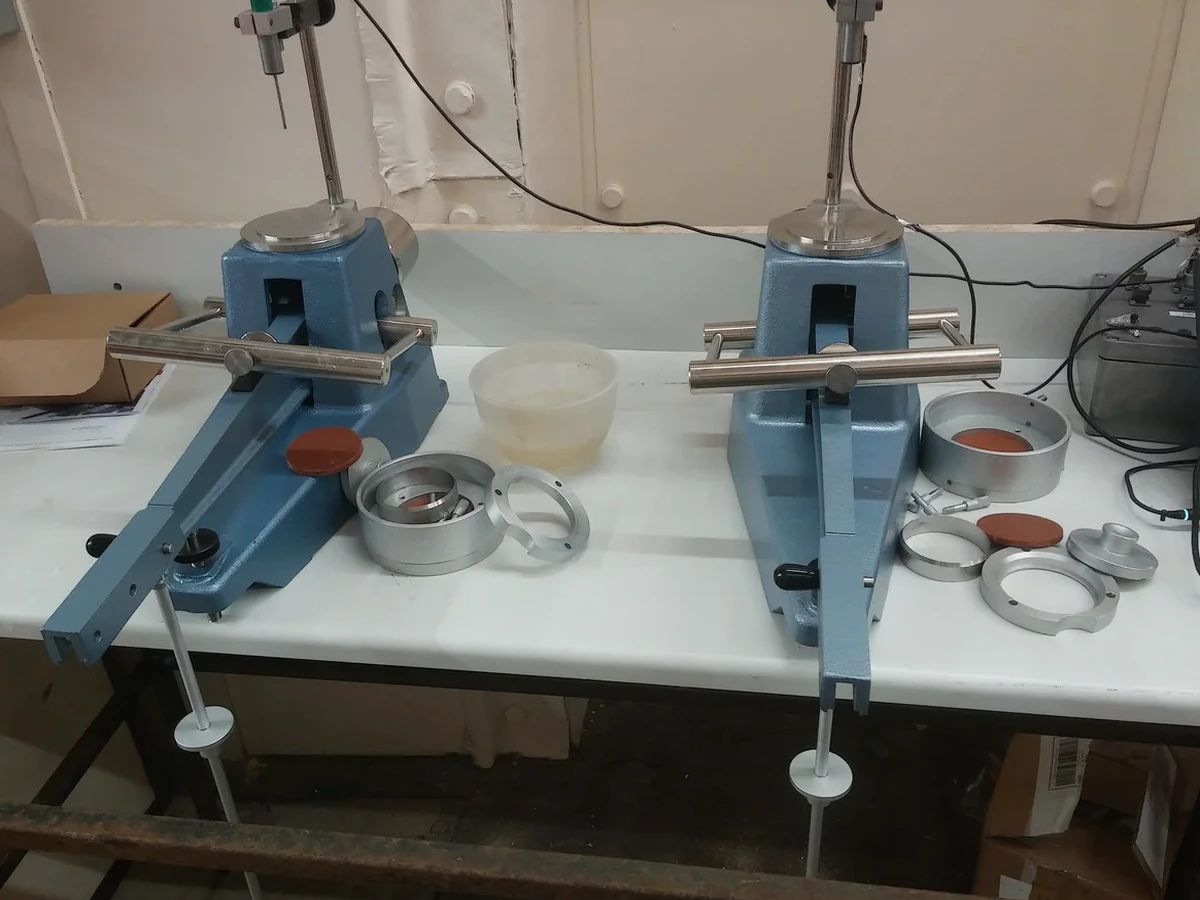
All laboratory procedures in Chattanooga must align with standards established by ASTM International, AASHTO, and local building codes adopted by the City of Chattanooga and Hamilton County. The International Building Code (IBC), as enforced locally, references ASTM D4318 for liquid limit, plastic limit, and plasticity index determinations, while ASTM D422 and D6913 govern particle-size analysis. The Tennessee Department of Transportation (TDOT) Standard Specifications for Road and Bridge Construction impose additional requirements for projects involving state-funded infrastructure, often mandating specific test frequencies and reporting formats. A thorough soil mechanics study integrates these standardized results to evaluate shear strength via direct shear (ASTM D3080) or triaxial compression (ASTM D4767), consolidation characteristics under sustained loading (ASTM D2435), and compaction potential through moisture-density relationships (ASTM D698 or D1557). Adherence to these norms ensures defensible data and regulatory compliance.
The types of projects in Chattanooga that demand comprehensive laboratory testing span the full spectrum of civil construction. High-rise developments in the downtown riverfront zone require deep foundation assessments supported by consolidation and strength tests to address compressible alluvial deposits overlying karstic bedrock. Residential subdivisions on the slopes of Signal Mountain and Lookout Mountain frequently encounter colluvial soils and weathered shales, where Atterberg limits and swell-consolidation testing guide grading plans and foundation remediation strategies. Transportation corridors such as the I-24/I-75 interchange expansions involve large-scale earthmoving, requiring compaction curve development and resilient modulus testing for subgrade evaluation. Even smaller commercial builds on infill lots benefit from basic classification and moisture-density relationships to avoid costly post-construction distress.
Available services
Common questions
What types of soil tests are typically included in a geotechnical laboratory program for a Chattanooga project?
A standard program commonly includes moisture content, Atterberg limits (ASTM D4318), particle-size analysis by sieving and hydrometer (ASTM D422/D6913), and moisture-density compaction testing (ASTM D698 or D1557). Depending on project scope, it may also involve direct shear tests, one-dimensional consolidation (ASTM D2435), unconfined compression on rock cores, and chemical analyses such as pH and sulfate content to evaluate aggressive soil conditions.
How do local geological conditions in Chattanooga influence the selection of laboratory tests?
Chattanooga's karst terrain and residual soils derived from limestone and shale weathering demand focused testing on plasticity and volume change potential. Atterberg limits are critical for identifying expansive clays in the Conasauga and Knox Group residuum, while consolidation tests help assess compressibility of alluvial and colluvial deposits. Limestone pinnacles and solution features also require careful correlation of laboratory strength data with rock quality designation from core logging.
What standards govern geotechnical laboratory testing for projects in Hamilton County?
Laboratory procedures follow ASTM International standards as referenced by the locally enforced International Building Code. TDOT Standard Specifications apply to state-funded transportation projects, prescribing test methods and minimum frequencies. Common standards include ASTM D4318 for Atterberg limits, ASTM D422 for particle-size analysis, ASTM D2435 for consolidation, and ASTM D3080 or D4767 for shear strength. All reporting must meet the requirements of the design engineer and local permitting authorities.
Why is a soil mechanics study important before designing foundations in Chattanooga?
A soil mechanics study synthesizes laboratory test results to predict how soils will behave under structural loads and environmental changes. In Chattanooga, where subsurface conditions can shift dramatically over short distances due to karst geology, this study quantifies bearing capacity, settlement potential, and slope stability. Without it, foundations risk differential settlement on compressible clays or damage from expansive soils, leading to costly repairs or structural failure.