We recently evaluated a failed section of Amnicola Highway in Chattanooga where the asphalt had alligator cracked within two years of resurfacing. The owner wanted answers, not guesses. We ran a full existing pavement evaluation that included FWD deflection testing and recovered cores for lab analysis. That data told us the base was saturated and the subgrade CBR was below 3. We designed a drainage retrofit and a 4-inch overlay with geogrid. The fix held. For similar pavement issues, we often pair this evaluation with a georradar survey to map subsurface anomalies and with CBR testing to confirm bearing capacity. Knowing the existing structure before you design saves money and prevents repeat failures.
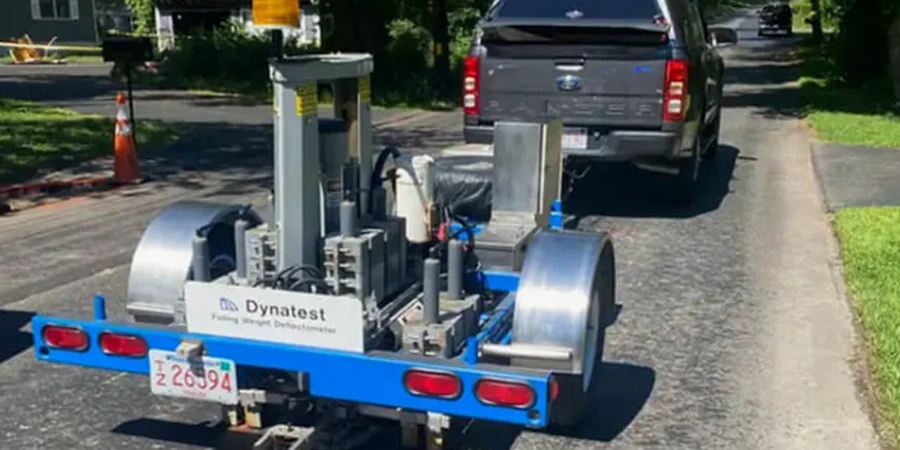
Pavement evaluation is not just about cracks: it is about measuring layer stiffness and water vulnerability to predict remaining service life.
Technical details of the service in Chattanooga
Local geotechnical conditions in Chattanooga
Chattanooga's urban core has expanded rapidly over the last two decades, with old industrial sites and river terraces converted into commercial corridors. Many of these areas have undocumented fill or buried utilities that complicate pavement evaluation. We have seen parking lots built on demolition debris that settled unevenly within months. Ignoring the existing pavement condition before overlay or reconstruction leads to premature cracking, reflective cracking, and ride quality complaints. The risk is higher along corridors like Broad Street and Market Street where traffic loads have increased significantly. A thorough evaluation identifies weak spots and allows selective repair instead of full removal.
Our services
We offer a complete suite for existing pavement evaluation in Chattanooga, from field testing to laboratory analysis and rehabilitation recommendations.
FWD Deflection Testing
Falling Weight Deflectometer testing on asphalt and concrete pavements. We measure deflection basins at 50-ft intervals and backcalculate layer moduli using AASHTO T-307. Results include structural number (SN) and remaining life.
Core Sampling & Thickness Verification
Recover 4-inch diameter cores from asphalt or concrete pavements. We measure thickness, record layer interfaces, and identify stripping or debonding. Cores are delivered to the lab for further testing.
CBR & Subgrade Strength Testing
Field CBR tests using ASTM D4429 to measure bearing capacity of base and subgrade. We correlate results with DCP data for continuous profiles. Useful for overlay design and subgrade improvement decisions.
Laboratory Material Characterization
Granulometry (ASTM D6913), Atterberg limits (ASTM D4318), and resilient modulus (AASHTO T-307) on recovered materials. We identify moisture susceptibility and provide layer coefficients for pavement design.
Common questions
How long does a typical existing pavement evaluation take in Chattanooga?
A standard evaluation for a parking lot or local road takes 2–4 days for field testing and another 5–7 business days for lab analysis and reporting. Larger corridors like Amnicola Highway may require 1–2 weeks of fieldwork.
What is the difference between FWD and DCP for pavement evaluation?
FWD measures deflection of the entire pavement structure under a simulated wheel load and is used for backcalculating layer moduli. DCP measures penetration resistance in the subgrade only and is faster for spot checks. We use both depending on the project scope.
Can you evaluate concrete pavements the same way as asphalt?
Similar but with different parameters. For concrete, we measure joint load transfer, slab curvature, and concrete cores for compressive strength and thickness. FWD is used but the analysis follows PCA or AASHTO rigid pavement methods.
How much does an existing pavement evaluation cost in Chattanooga?
Costs typically range between US$1,310 and US$3,850 depending on the number of test points, coring requirements, and laboratory testing. Contact us for a scope-specific quote.